Professions and their illustrations
The "Holy Grail" family tree template is the only template that lets you choose the profession illustrations yourself in both bottom corners. We've prepared 22 hand-drawn profession illustrations for you — pick, for example, a blacksmith, miller, seamstress, shoemaker, miner, forester and others. For each profession you'll also find its German and Latin name, as you might know it from parish registers, and a short account of how the trade fared through history.
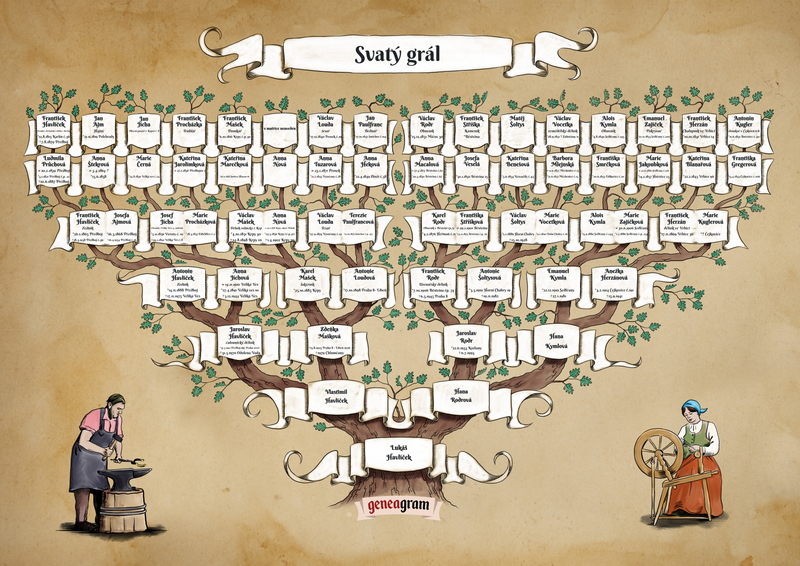
This is what a sample of the "Holy Grail" template looks like with illustrations of a blacksmith and a spinner.
List of illustrated professions

Cooper, barrel maker
German: Bender, Binder, Böttcher, Büttner, Fassbinder, Schäffler
Latin: Doleator, Doliarius, Vinctor
Patron saint: Sv. Urban z Langres
Large-volume vessels were made from steamed staves held together with hoops — tubs, buckets, vats and troughs for the household, and barrels for beer and wine.
Vessels made of joined wooden staves have been used in our lands since Roman times for drawing water or storing drinks. The wood had to season for several years before it could be worked by steaming and planing. The whole construction was held together by iron hoops, and watertightness was achieved by coating it with hot pitch. In the Middle Ages, coopers who made everyday vessels and those who made barrels became separate trades. The former made tubs, buckets, butter churns, troughs and similar items for common use from softwood, while the latter made casks and barrels from hardwood, mainly for large-scale beer and wine production. Many names of individual vessels also became names of dry and liquid measures.
Grinder, knife sharpener
German: Schleifer
Latin: Acutiator, Cotiarius, Politor, Turbator
Patron saint: Sv. Lucie
The grinder sharpened iron tools, which was needed everywhere but only briefly at a time. That made it an itinerant and poorly paid trade.
Iron tools hand-forged by a blacksmith were of good quality and lasted a long time, but they were not exactly cheap, nor were they disposable goods. Because of this, and because of heavy use, tools for cutting and shearing had to be sharpened fairly often. Professional grinders sharpened blades on rotating stone wheels, which is why millers, who knew how to make millstones and had no shortage of motive power, sometimes practised this trade as well. Itinerant grinders travelled from fair to fair (sometimes with a monkey in tow) or went door to door with a foot-powered grinding cart. They did not earn much, even though there was plenty of work, so some grinders specialised in just one item, such as razors.

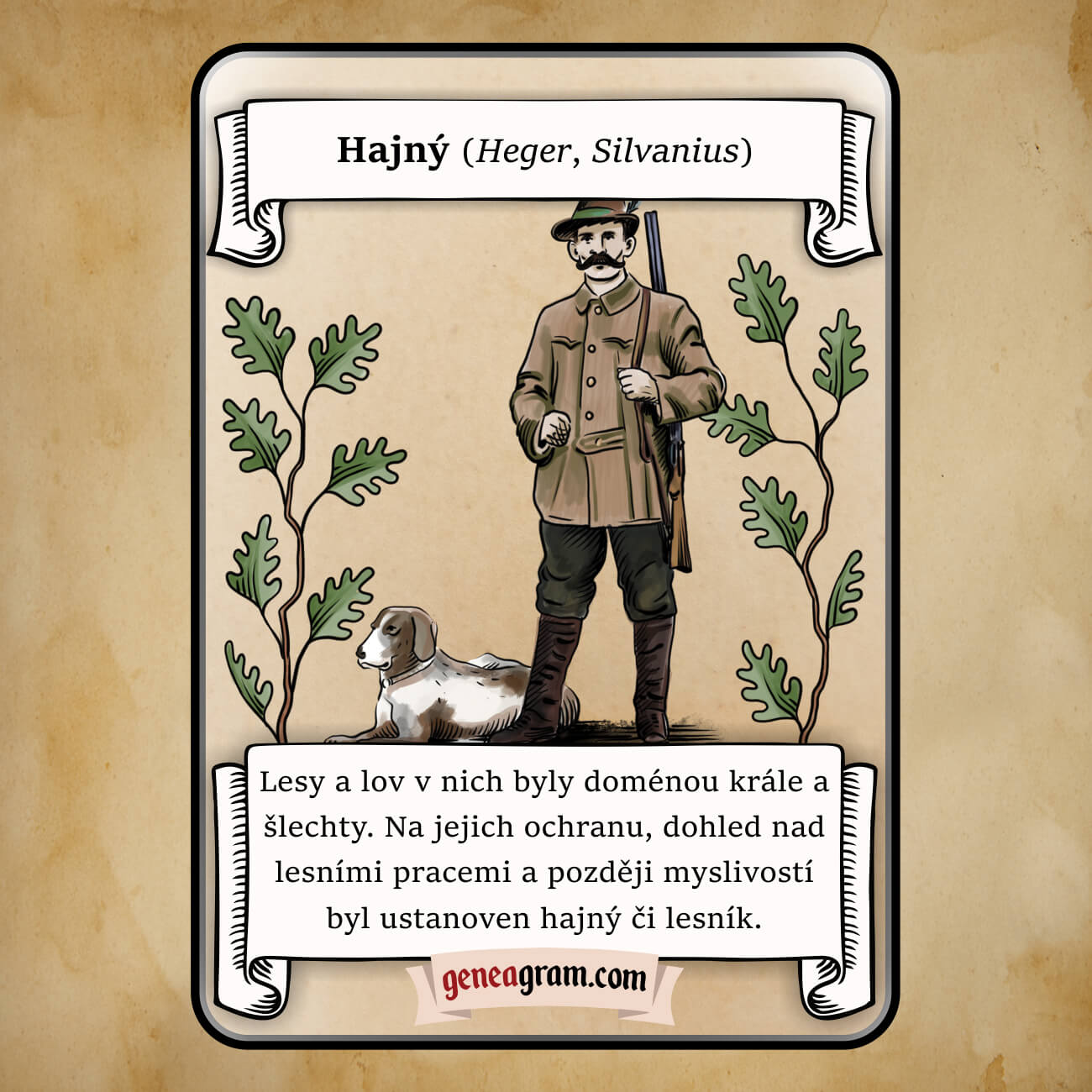
Gamekeeper, forester
German: Heger, Jäger, Weidmann, Förster
Latin: Silvanus, Custos silvarum, Venator, Forestarius, Saltuarius
Patron saint: Sv. Jan Gualbertus, Sv. Hubert
Forests and the hunting in them were the domain of the king and nobility. A gamekeeper or forester was appointed to protect them, oversee forest work and, later, hunting.
Across Europe, forests were feudal property, belonging to kings, nobles, monasteries and church princes. Only the owner was allowed to hunt game, and he guarded this privilege fiercely. Besides hunting, forests were also used for felling timber, burning charcoal, smelting glass, producing potash and grazing livestock. The forests were deep, but not empty of people. To guard against poachers and to oversee forestry work, the lord of the manor appointed gamekeepers, who enjoyed a privileged position compared to other subjects. Large estates had many forest districts, so gamekeepers often moved over long distances. The profession was passed down from generation to generation, and forester families intermarried with one another.
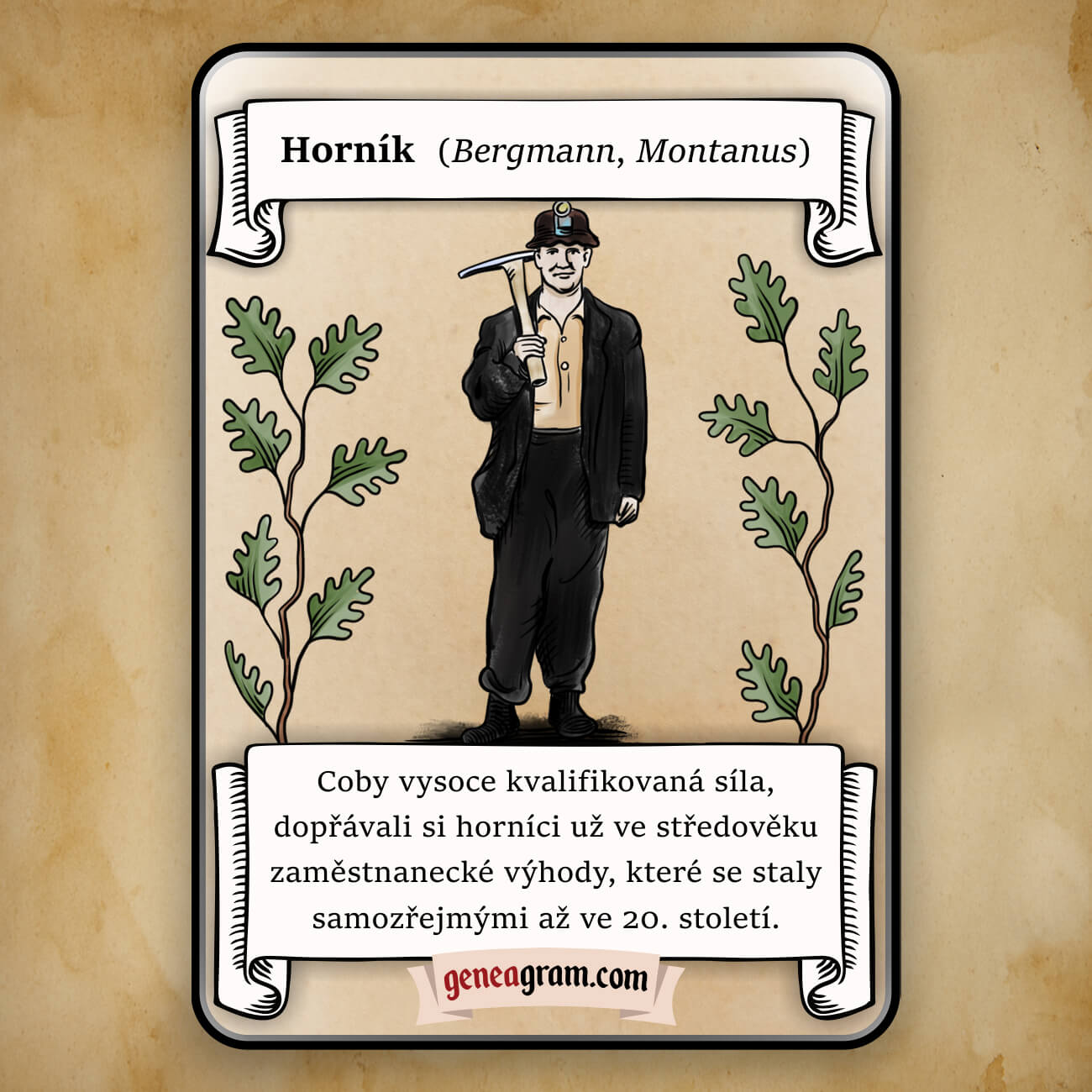
Miner
German: Berger, Bergmann, Hauer, Knappe, Kumpel
Latin: Fodinarius, Fossor, Metallarius, Metallicus, Montanus
Patron saint: Sv. Barbora, Sv. Prokop
As highly skilled workers, miners already enjoyed employment benefits in the Middle Ages that would not become commonplace for everyone else until the 20th century.
The mining of precious metals was a royal privilege. It was therefore a well-controlled and protected line of work, subject to its own special legal order. Roman law first reached our lands in the form of a mining code. As a result, miners — a highly skilled and much sought-after workforce — enjoyed unprecedented labour protections. They were entitled to a minimum wage, their original working day was just six hours, they did not work on Sundays and holidays, they received paid overtime, and they could sue their employer. Health and life insurance existed for them, since it was a very hazardous occupation. As mining gradually declined, however, they lost these privileges. The rise of industrial coal mining brought poor treatment and miserable pay, which is why strikes became common from the 19th century onward.

Potter
German: Hafner, Töpfer
Latin: Figulus, Fornator, Legenarius, Ollator
Patron saint: Sv. Kateřina Alexandrijská
Pottery making is certainly one of the oldest crafts. All it takes is clay and skilled hands — though for truly fine work a potter also needs a kick wheel and a kiln.
It is no accident that prehistoric cultures are identified by the pottery they used. Vessels served everyday needs, while also carrying folk artistic patterns and styles down through generations. Clay was easily available, dug from surface clay pits. Excellent pottery was already being made here by the Celts, using specialised kilns and a potter's wheel. The same level of technical skill was not matched again until the Middle Ages, when kilns capable of firing at high temperatures appeared (such pottery no longer leaks) and glazing came into use. Alongside pottery, the production of stove tiles and floor tiles also developed.
Wheelwright
German: Wagner, Stellmacher
Latin: Currarius, Currifex, Rotarius, Rotifex, Vehicularius
Patron saint: Sv. Kateřina Alexandrijská
The wheelwright made cart wheels, carts and other wooden parts of vehicles in the past, as well as other necessary farm equipment.
Replacing the solid wooden wheel with a spoked one called for a specialised trade. Wheelwrights worked mainly in towns, which served as transport hubs and centres of trade. Carts allowed a dramatic increase in the volume of goods transported. On generally poor roads, however, wheels were consumable goods that constantly needed repair and replacement. All four wheels of a cart were always made together from the same wood, to keep the weight even. The wheelwright made the hub, the spokes and the felloe (rim), but he could not do without the blacksmith, who had to fit the hub and the whole wheel with iron.

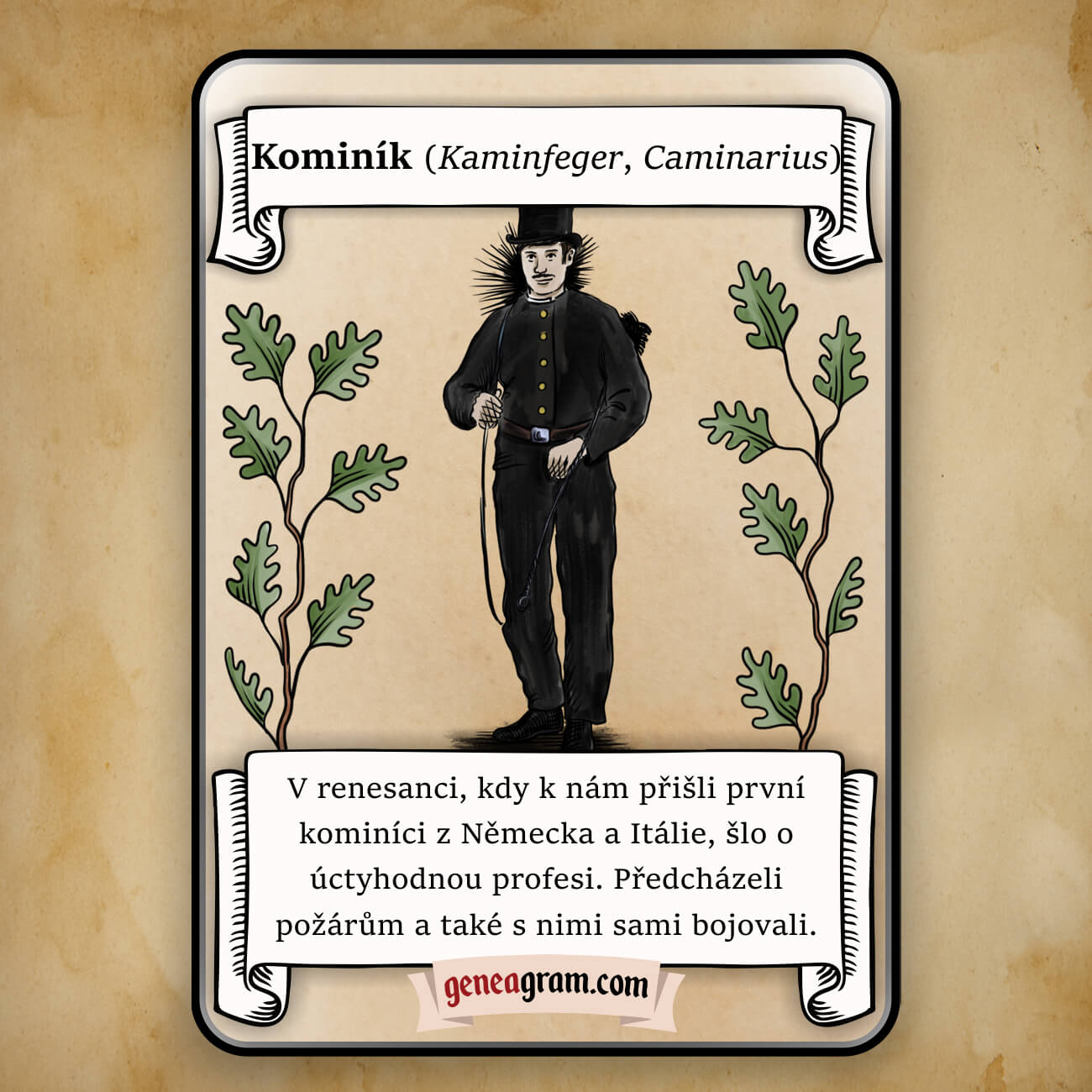
Chimney sweep
German: Essenkehrer, Kaminfeger, Rauchfangkehrer, Schornsteinfeger
Latin: Caminarius, Caminator, Fumarius
Patron saint: Sv. Florián
In the Renaissance, when the first chimney sweeps arrived here from Germany and Italy, it was a respected profession. They prevented fires and also fought them themselves.
Chimney sweeps, originally mostly foreigners, came to Bohemia during the Renaissance, when stoves and a new type of chimney began to be used in towns. Their profession also gained importance from the development of fire-safety regulations, which did not spread to the countryside until well into the 19th century. Until then, everyone in the village swept their own soot and was responsible for their own safety, which meant fires were more common. The arrival of a chimney sweep was therefore genuinely a stroke of luck. What's more, before fire brigades existed, it was the chimney sweeps who fought the fires.
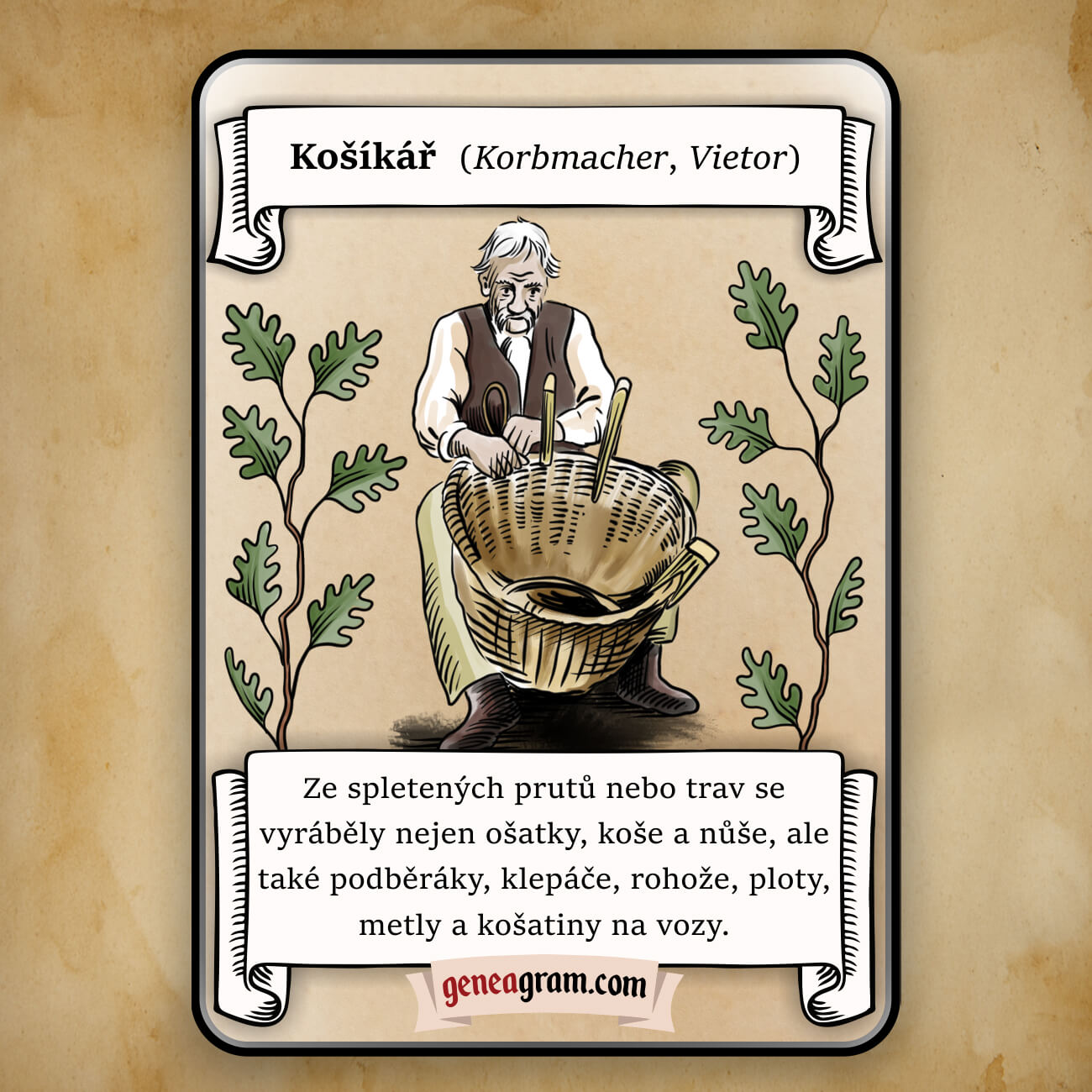
Basket maker
German: Korbmacher, Korbhersteller
Latin: Sportifex, Vietor, Vitor
Patron saint: Sv. Jan Evangelista
Woven withies or grasses were used to make not just baskets and hampers, but also landing nets, carpet beaters, mats, fences, brooms and cart racks.
Basket weaving is probably one of the very oldest ways of making vessels — the first pottery likely arose from baskets being coated with clay. Techniques for weaving various plant materials were common skills in the countryside, and the tradition survives today in Easter whip-braiding, even though knowing how to weave a basket was once just as ordinary. Weaving was often a way for the elderly or disabled, who could not manage ordinary farm work, to earn extra income. Specialised basket makers mostly lived near water, where willows grew, their withies being the main raw material — though grasses and thin wooden strips were also used.
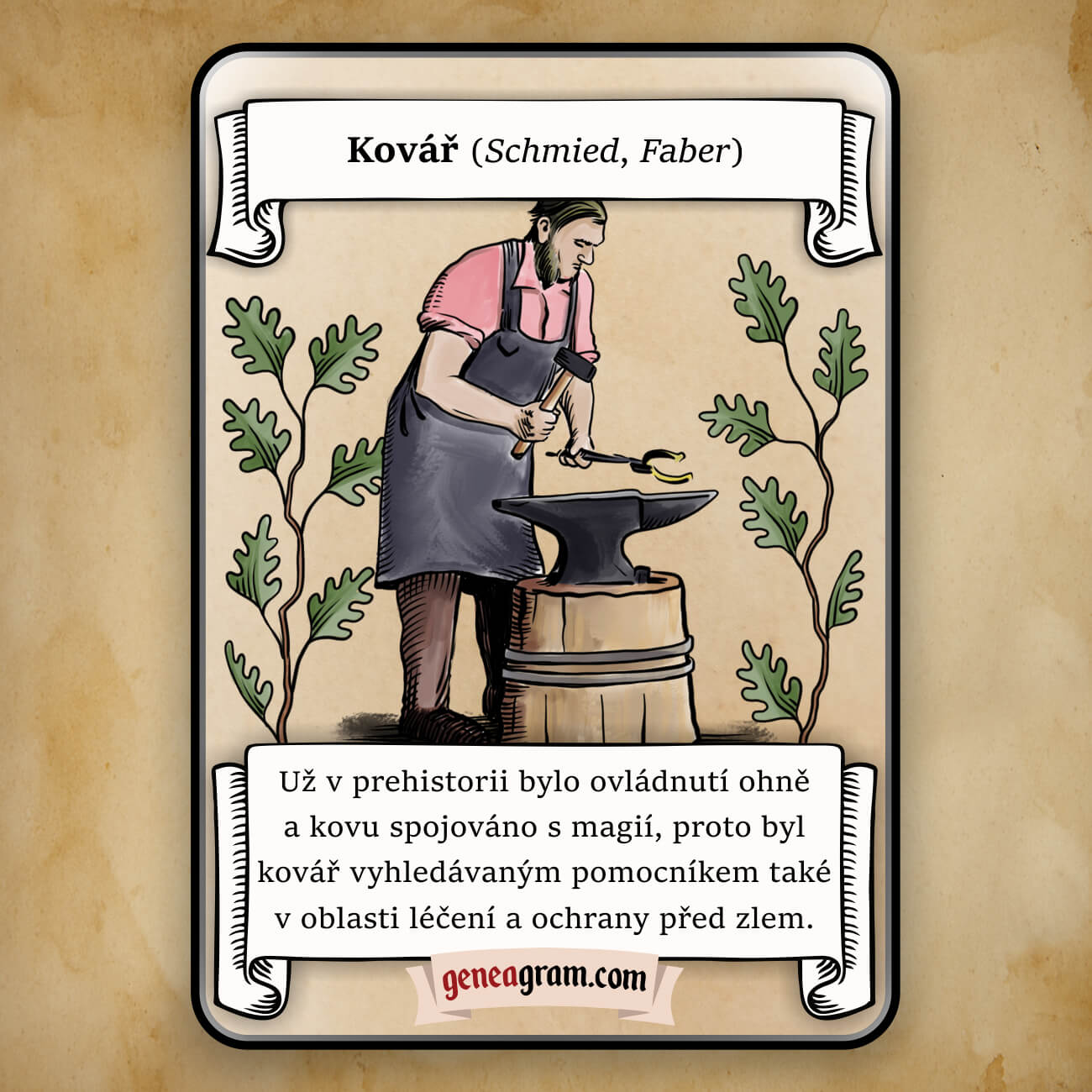
Blacksmith
German: Schmied, Hufschmied
Latin: Faber, Ferrarius, Sufferator
Patron saint: Sv. Petr, Sv. Eligius
Since prehistoric times, mastery of fire and metal was associated with magic, which made the blacksmith a sought-after helper in healing and warding off evil as well.
Until the arrival of forges and ironworks in the late Middle Ages — the first large-scale production plants — every iron tool had to be hand-forged by a blacksmith in his workshop. Without his work, there would have been no ploughing, harvesting, forest clearing, house building, comfortable travel or waging war. Blacksmiths could work for a wage for the village or the lord, or practise their trade as free craftsmen. Since prehistoric times, working with fire and iron had been linked to magic, so people would come to the blacksmith or his wife for help with various ailments. They made protective amulets and recited charms. Folklore preserves many superstitions about blacksmiths that nonetheless have a basis in truth — they were experienced veterinarians, knew their herbs, and pulled neighbours' teeth. Smaller blacksmiths specialising in making and fitting horseshoes are known as farriers.
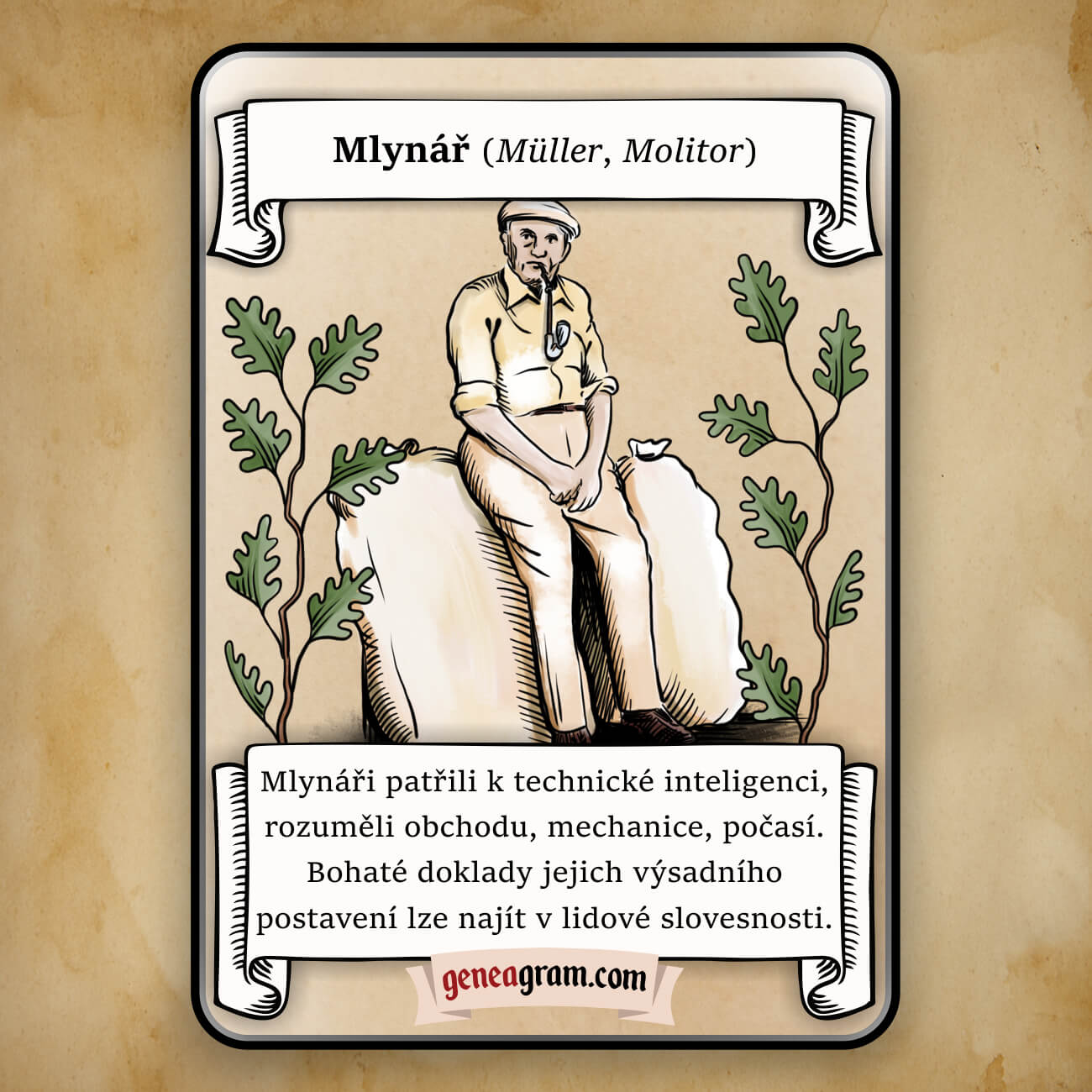
Miller
German: Müller
Latin: Farinarius, Molendinator, Molinarius, Molitor
Patron saint: Sv. Kateřina Alexandrijská
Millers belonged to the technical intelligentsia of their time, understanding trade, mechanics and weather. Rich evidence of their privileged status survives in folklore.
In the Middle Ages and the early modern period, the basic mechanical power source was human labour, or that of domesticated animals turning a treadmill. It was easily available, but its output was small and severely limited technological possibilities in production. Until the arrival of the steam engine, mills were the sole exception, using either water or wind power. From a technical point of view, sawmills, water-powered forges, oil presses and stamping mills can all be grouped alongside grain mills. It is therefore important to realise that a miller was not just a producer of flour, but also a kind of mechanical engineer, a man with good mathematical and scientific knowledge, and often a well-read man too.
Do you like the illustrations?
You can choose any of these professions in the Holy Grail family tree template. All you need is a package of credits — 1 credit = 1 family tree on any template.
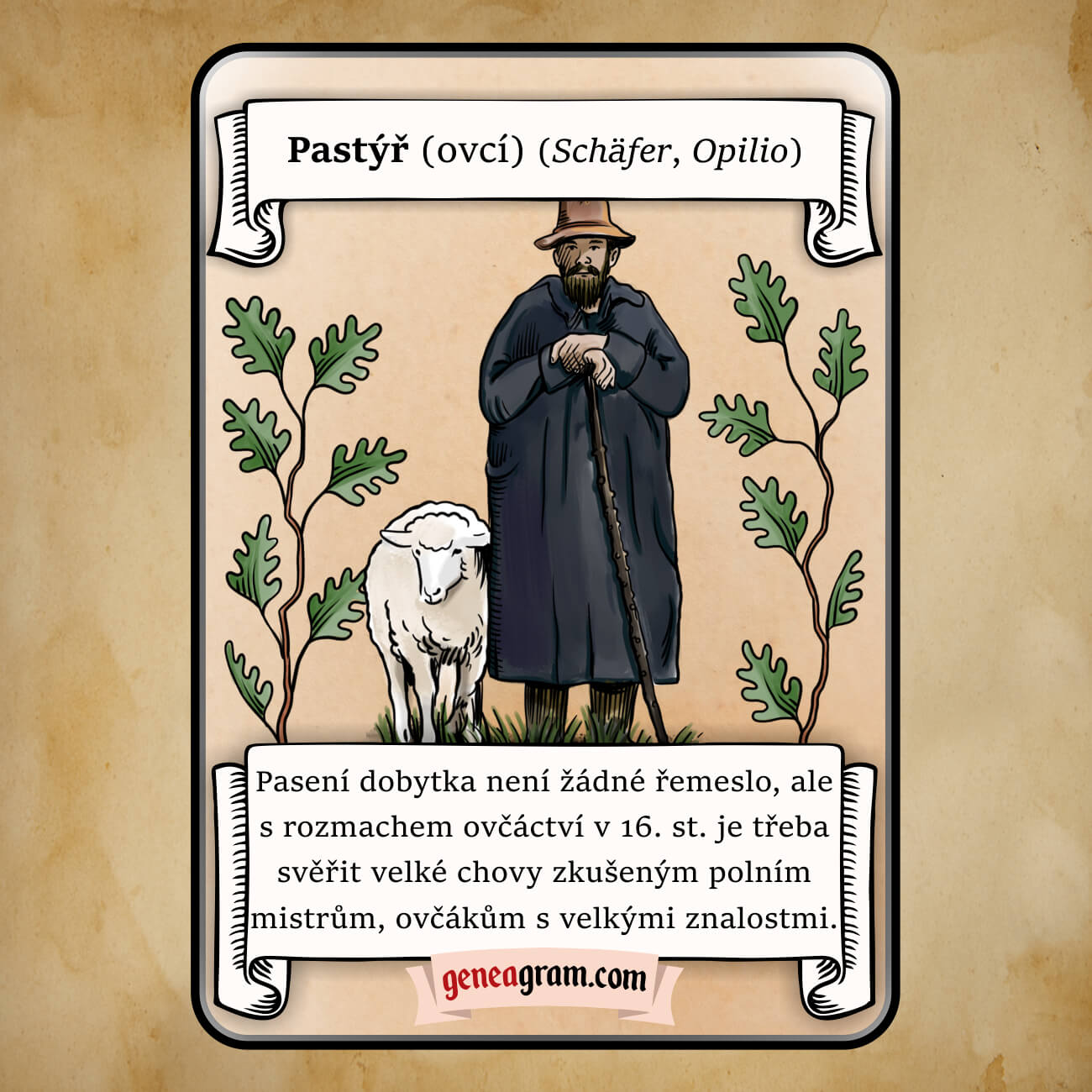
Shepherd
German: Schäfer
Latin: Opilio
Patron saint: Sv. Wolfgang, Sv. Vendelín, Sv. Jan Evangelista
Herding livestock is not a craft as such, but with the boom in sheep farming in the 16th century, large flocks had to be entrusted to experienced master shepherds with extensive knowledge.
Pastoralism, although originally tied to migration, already paved the way — thousands of years ago — for the shift to a settled life based on farming the land. In agricultural societies, grazing depended on farming efficiency and the availability of fodder, which remained in significant short supply until the 19th century. Farmers could hardly wait to drive their thinned livestock out to meadows, fallow fields and forests in spring. Pastures were communal, shared by the whole village, and the animals were looked after by the village shepherd. Shepherds lived on the margins of society and were sometimes regarded as disreputable. As textile production grew, so did demand for wool, and the nobility in particular began setting up large sheep farms, tended by professional shepherds also known as field masters. These men, by contrast, were respected as professionals versed in veterinary care, breeding, building sheepfolds and organising the entire wool-producing operation.
Baker
German: Bäcker
Latin: Furnarius, Panifex, Panista, Pistor
Patron saint: Sv. Florián, Sv. Klement, Sv. Vavřinec
Bread was the staple of daily food. In the countryside it was baked at home. In towns, several kinds of bread were baked, along with other savoury and sweet pastries.
Man does not live by bread alone — and yet, in material terms, that is more or less exactly what people did. But bread was not just bread: in the Middle Ages the term could cover any kind of baked goods, and professional bakers always prided themselves on a wide selection. Quality depended on the flour used; ground quartz dust and bran were, in many places, an unwelcome but unavoidable filler. In the countryside, rye bread was baked, while wheat flour was used for cakes and buns — though these were not as sweet as today, since sugar was not yet commonly available. In towns, sweet pastries were made by specialist confectioners and gingerbread makers.

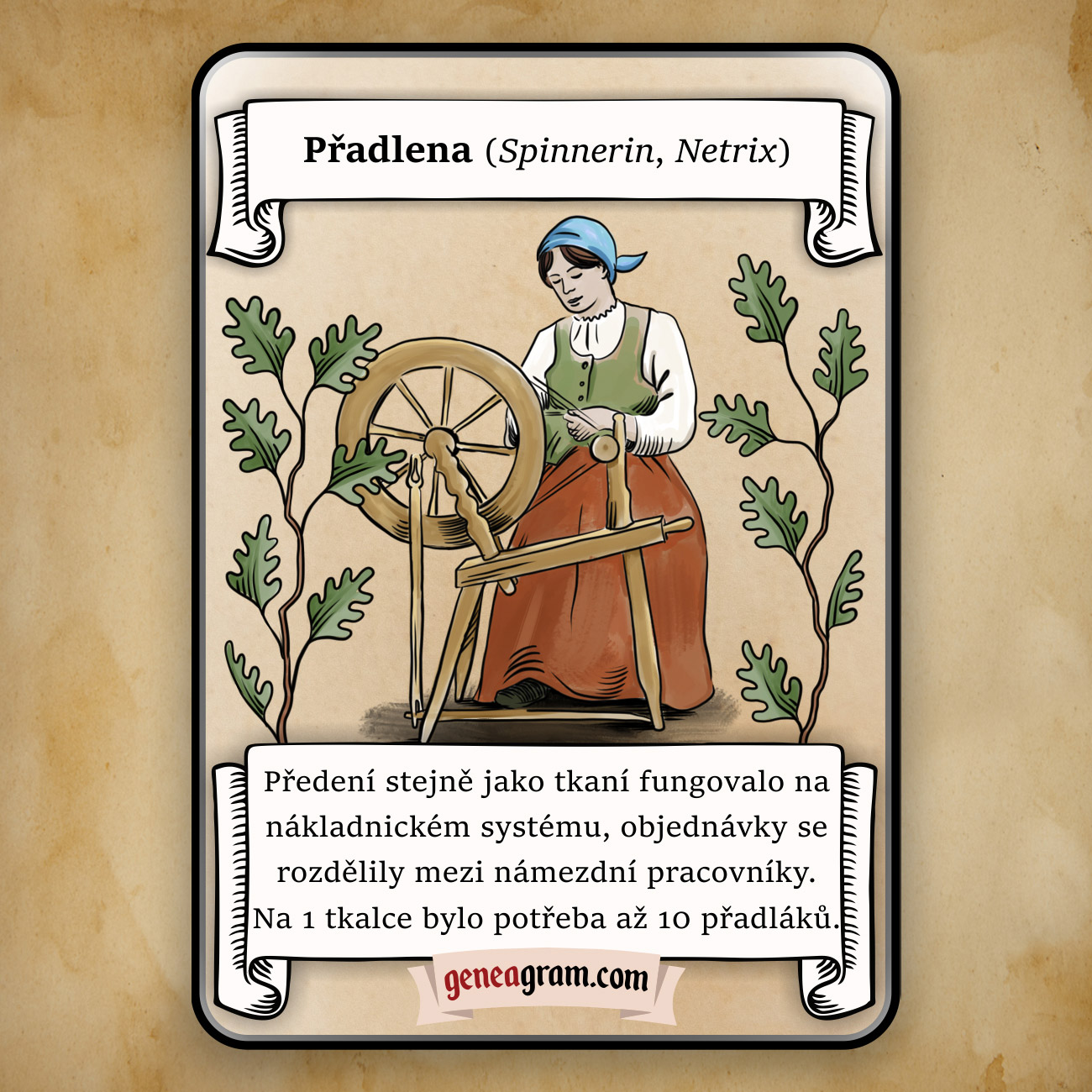
Spinner
German: Spinnerin
Latin: Netrix
Spinning, like weaving, operated on the putting-out system, with orders divided among home workers — one weaver needed as many as ten spinners to keep him supplied.
An old saying holds that a woman who cannot spin will never marry. Spinning was one of the ordinary household tasks, regardless of what the yarn was ultimately used for — whether for one's own sewing needs or for large-scale production. Even after the spinning wheel arrived here from Flanders, it remained a very time-consuming task requiring a great deal of patience. Processing flax and wool was technically much the same, and both required a broad network of spinners to keep up with demand.
Farmer, peasant
German: Bauer
Latin: Agricola
Patron saint: Sv. Isidor z Madridu, Sv. Prokop
The doctrine of the three estates was a founding principle of medieval society, which it divided into those who fought, those who prayed, and the country folk who fed their protectors.
The laboratores, the third estate — those who work — meant the peasants. The peasant's position carried important symbolic weight, but even though the entire economy of traditional society rested on land and agricultural production, the reality of everyday life was very harsh. Just as society was stratified by wealth and privilege, the peasantry itself was highly diverse, and the poorest made up the majority. Broadly speaking, one can distinguish those who owned their own farmstead and fields (yeoman farmers, and, in part, smallholders), those who owned their own dwelling but whose holding was not enough to live on (cottagers, gardeners, sub-tenant farmers), and finally those who lived as tenants or worked in service (lodgers, farmhands, day labourers).


Butcher
German: Fleischer
Latin: Carnarius
Patron saint: Sv. Bartoloměj Apoštol, Sv. Vavřinec
In the era of town guilds, butchers belonged to the craft elite. As today, they handled the entire process of meat processing, from buying the animals to making sausages.
Meat spoils quickly, which is why villages staggered their slaughtering, with neighbours sharing the meat among themselves. In towns it was initially much the same, with livestock commonly kept in yards or just outside the town walls. As towns grew, demand rose for this more expensive but nutritionally richer food source. More people could now afford the luxury of meat, giving rise to a specialised trade dominated by a wealthy butchers' guild. According to legend, butchers distinguished themselves during the siege of Prague in 1310, which is why they were granted a silver lion with an axe for their coat of arms — a symbol that still decorates their shops today.
Seamstress, dressmaker
German: Schneiderin
Latin: Sartrix
Patron saint: Sv. Lucie
In the Middle Ages men were not allowed to take women's measurements, which gave rise to the trade of dressmaking. Seamstresses also made underwear and other clothing items.
In villages it was common for women to sew clothing themselves. In towns, seamstresses split off from tailors, either because a male master could not "work on" female customers, or because of certain tasks — underwear in particular — that tailors did not wish to perform. It would be hard to find another trade so strictly divided along gender lines. Dressmaking for women became established alongside the rise of fashion, although independent salons only emerged rarely, and only in fairly recent times. Seamstresses mostly worked at home, or at their customers' houses.

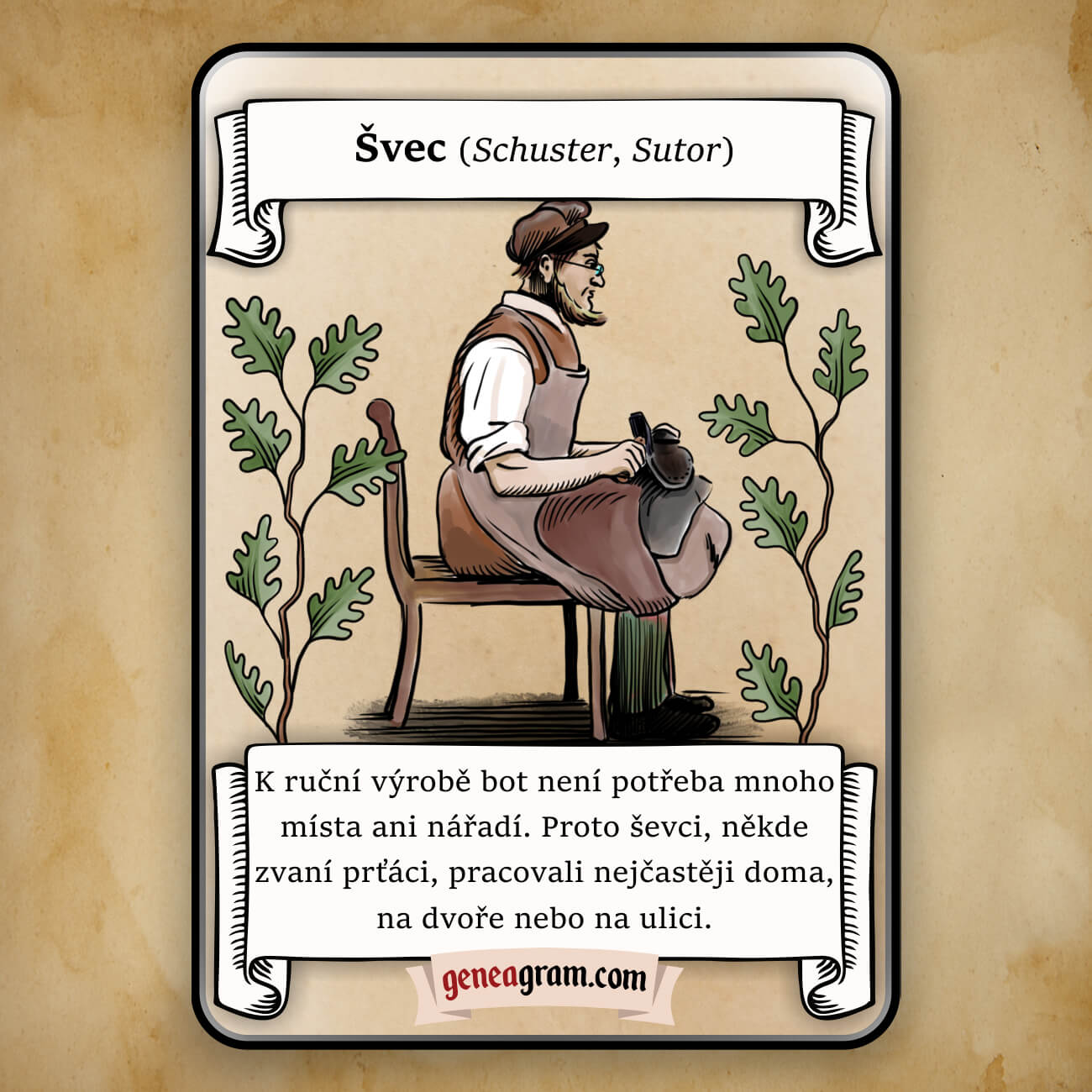
Shoemaker, cobbler
German: Schuster
Latin: Sutor
Patron saint: Sv. Kryšpín
Making shoes by hand does not require much space or many tools. That is why shoemakers most often worked at home, in the yard, or out in the street.
The footwear made by shoemakers was made exclusively from leather, usually cowhide or calfskin. It was cut to shape using a last, always made to measure for the customer's own foot. Well-made shoes were very comfortable and lasted a long time. In the Middle Ages, shoemakers were divided into those who made new shoes and those who repaired or resoled old ones, although records show the latter also made new footwear on occasion. In larger shoemaking workshops, work was divided by skill level: the master made the uppers, the senior journeyman the soles, while the junior journeyman and the apprentice handled repairs.
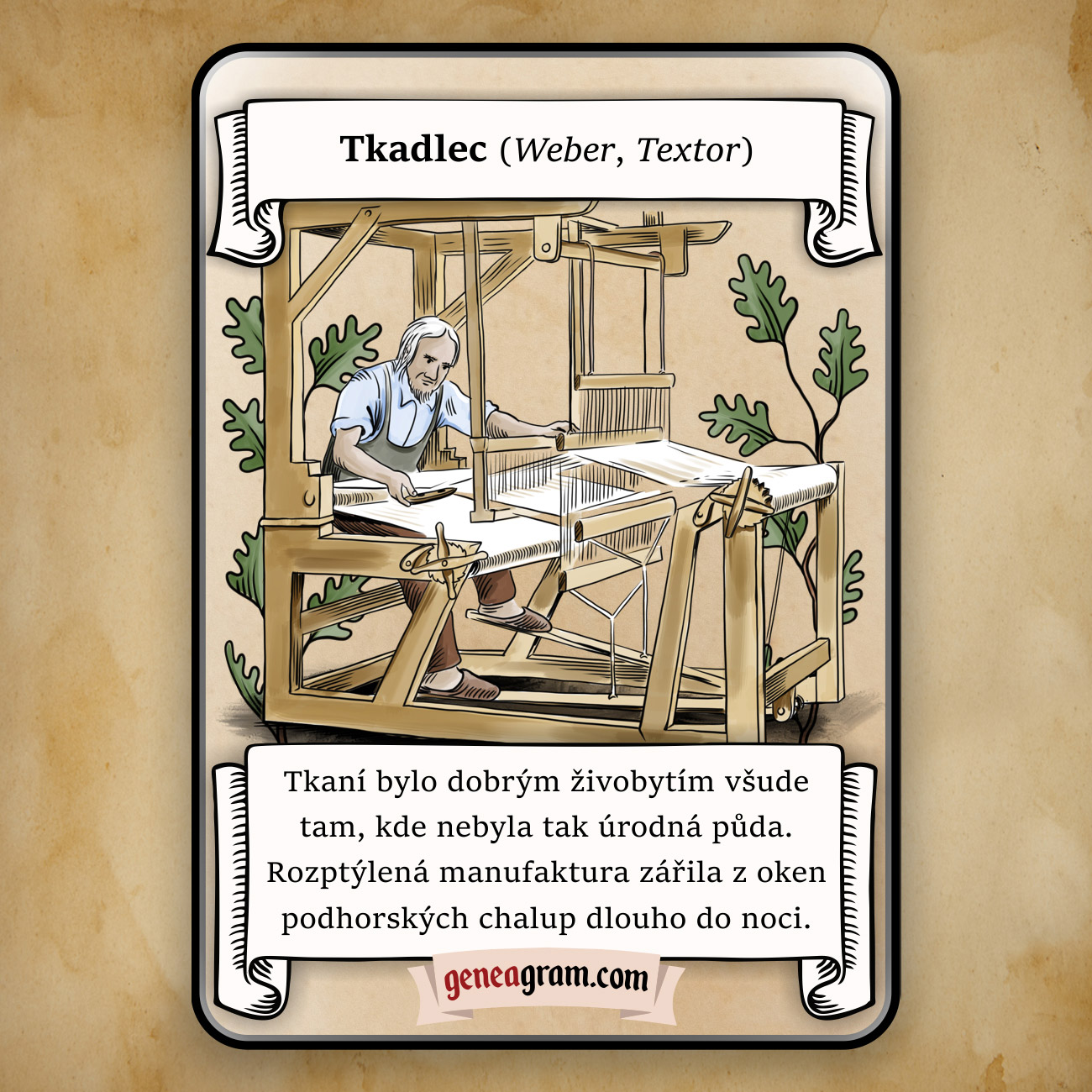
Weaver
German: Weber
Latin: Textor
Weaving was a solid livelihood wherever the soil was not fertile enough for farming. This scattered cottage industry kept lights burning late into the night in foothill cottages.
Although more or less the same weaving technology was used for various textile materials, we must clearly distinguish between two branches of production: linen weaving (flax, hemp and, later, cotton or silk) and woollen cloth weaving (wool). Linen production dominated in every region — linen was used to make clothes, underwear, bedding, tablecloths, sacks and sailcloth. A striking feature was the high share of women's labour, especially in preparing the fibre. Another typical feature was that production was scattered across individual rural households, even once local goods were already being exported far overseas. This was the so-called putting-out system, in which merchants (factors) bought up cloth from independently working weavers. Obtaining and preparing wool was more demanding, and its production became more centralised — wool weavers worked for a wage, and the first manufactories in our lands emerged at the end of the 18th century.
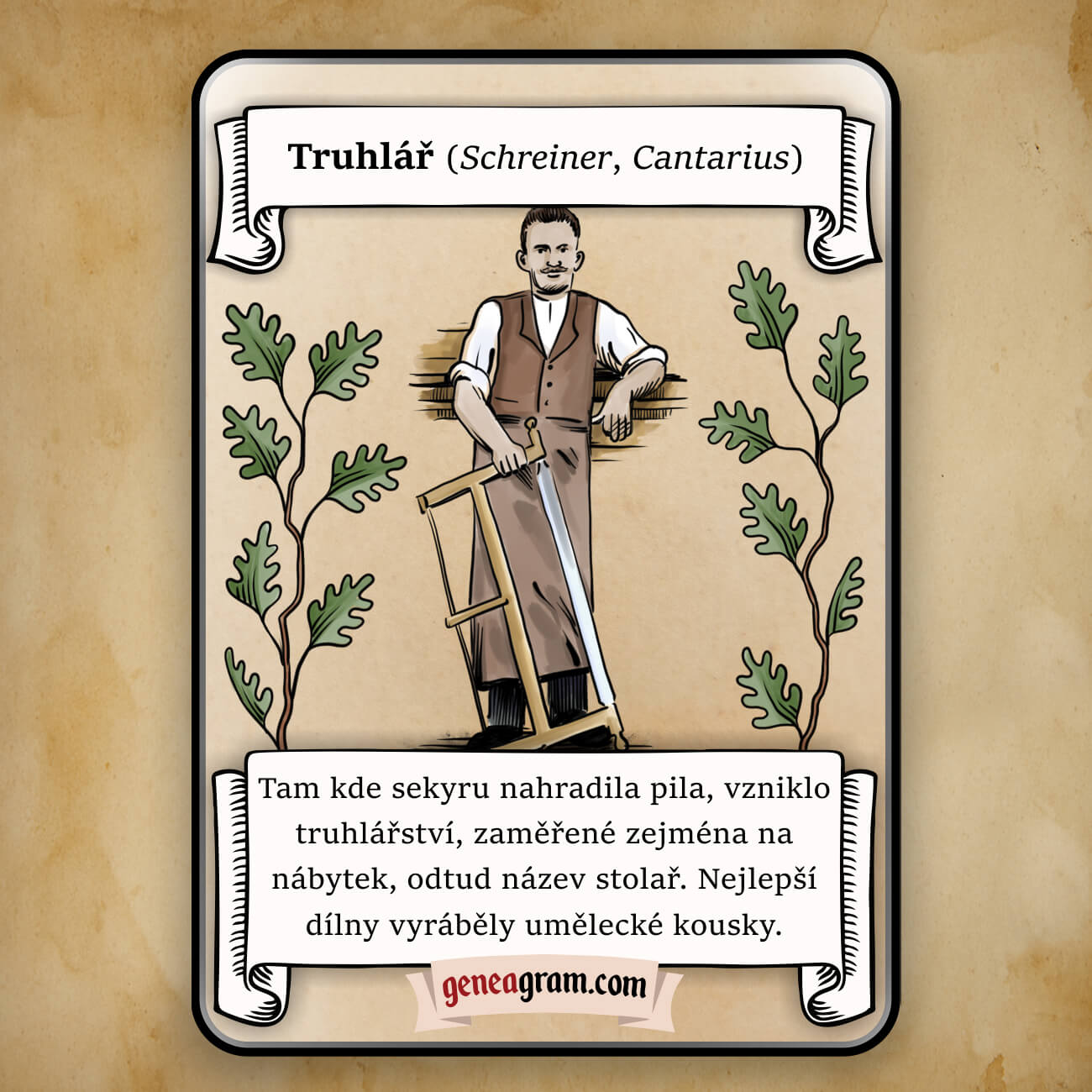
Carpenter, joiner
German: Schreiner
Latin: Cantarius
Patron saint: Sv. Josef
Where the axe gave way to the saw, joinery emerged, focused chiefly on furniture. The finest workshops produced true works of art.
The key difference between carpentry and joinery lies in the tools used. The carpenter works with an axe, while the joiner shapes his products from saw-cut planks, and thanks to further inventions such as the plane, could take on ever finer and more precise work. Besides furniture, joiners also worked on wall and ceiling panelling and made doors and windows. Since rough carpentry work was usually enough for country needs, medieval and early modern joinery workshops tended to produce luxury goods instead. As more advanced technology spread, joinery gradually became an everyday trade, while carpentry declined and became concentrated mainly on building roof trusses.
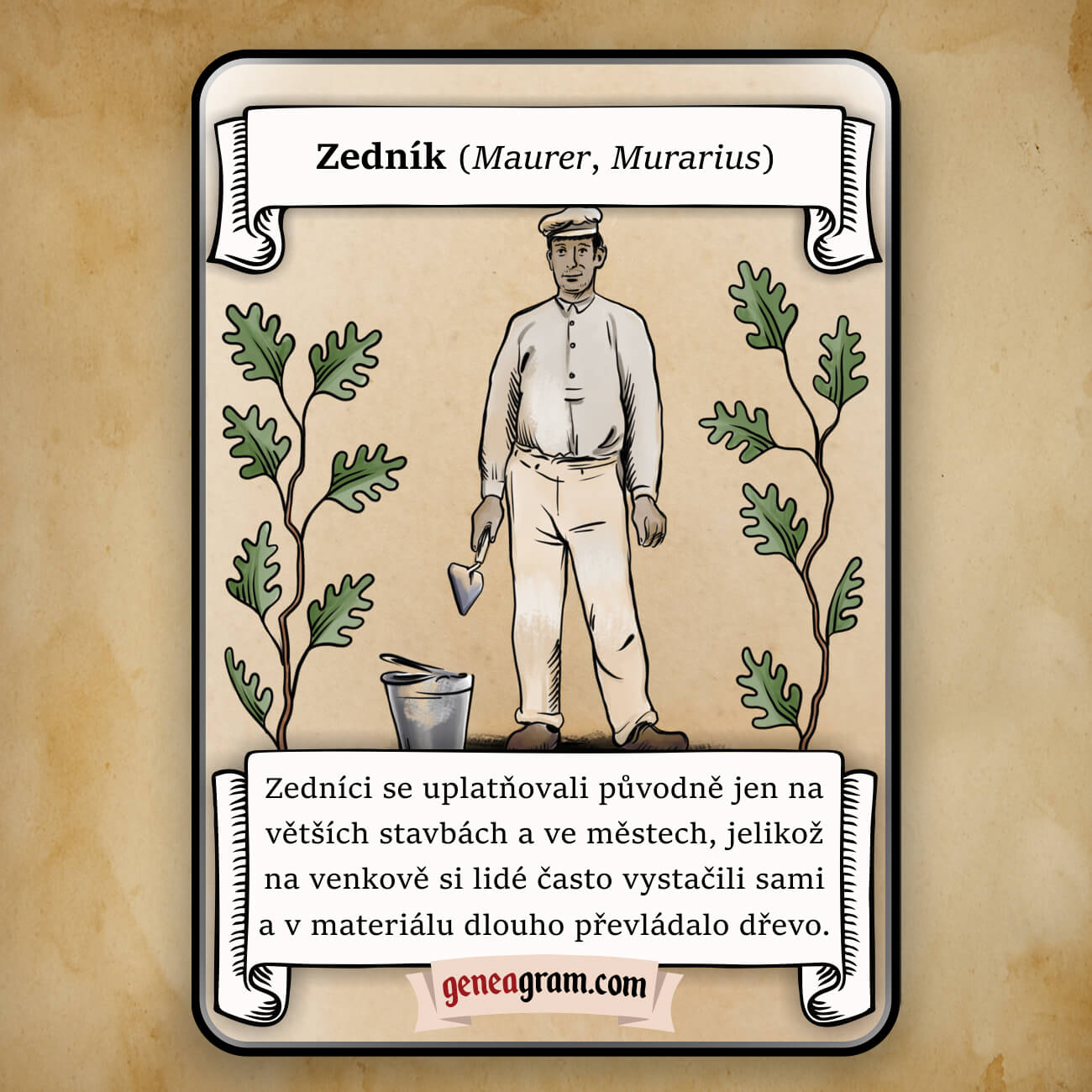
Bricklayer, mason
German: Maurer
Latin: Murarius
Patron saint: Sv. Štěpán
Bricklayers were originally employed only on larger buildings and in towns, since in the countryside people often managed on their own and wood remained the dominant material for a long time.
Wherever wood was plentiful, building relied on wood. Stone buildings were costly, which is clearly reflected in the number of surviving medieval monuments — churches, the residences of nobles and kings, and burghers' houses. That is also why there were never many professional bricklayers, since villagers could usually manage on their own. But precisely because wood was used for everything, some regions became entirely deforested, and an accessible substitute had to be found: brick. To this we can add, in the 18th and 19th centuries, the influence of urban fashion spreading to the countryside, where wealthy farmers began having brick farmhouses built. This period also saw the first building regulations enter the trade, meaning above all a larger number of genuinely trained bricklayers.
Create a family tree with your ancestors' professions
You'll find all these illustrations in the Holy Grail. Register for free, choose the professions that appeared in your family, and create a family tree unlike anyone else's.